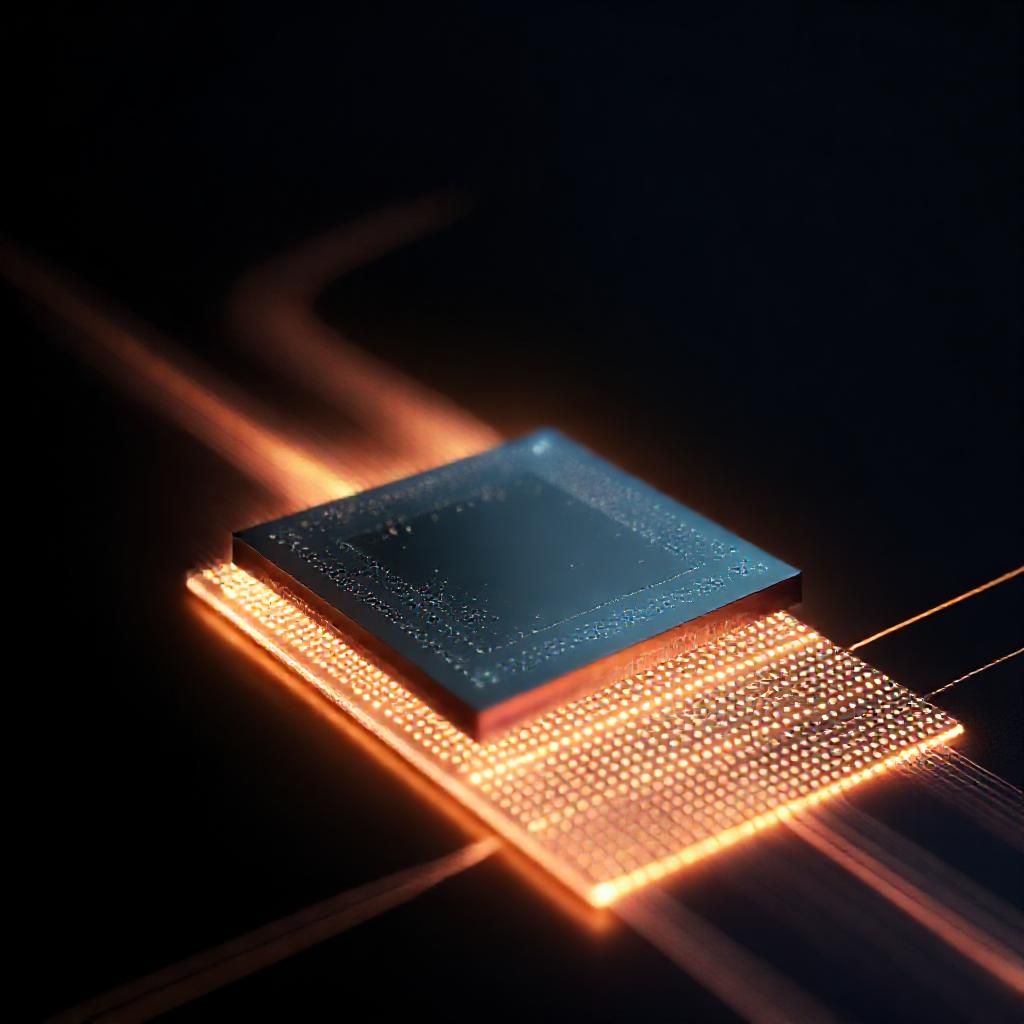
### Harvard’s Ultra-Thin Metasurface: A Quantum Leap in Computing
In the world of quantum computing, where technology seems to leap forward at the speed of light, a new breakthrough from Harvard University is turning heads. Imagine a component so thin it could almost disappear if you blinked, yet powerful enough to revolutionize the future of computing. This is the promise of Harvard’s latest innovation: an ultra-thin metasurface designed to replace the bulky and intricate optical components traditionally used in quantum systems.
#### The Quantum Revolution on a Chip
Quantum computing, often seen as the holy grail of computational power, relies heavily on complex optical components to manipulate quantum bits, or qubits. These components are essential for generating entangled photons and performing the sophisticated operations that quantum computing demands. However, their size and complexity have posed significant barriers to scalability and practicality — until now.
Researchers at Harvard have ingeniously condensed these optical systems into a single, nanostructured layer, thinner than a human hair. This metasurface is not just a reduction in size; it’s a transformative leap in design and function.
#### Harnessing the Power of Graph Theory
One of the most fascinating aspects of this breakthrough is the use of graph theory, a branch of mathematics that deals with networks of nodes and edges. The team at Harvard employed graph theory to streamline the design of these metasurfaces, ensuring they can efficiently generate entangled photons and execute complex quantum operations.
This clever application of mathematical principles not only simplifies the metasurface’s design but also enhances its stability and performance at room temperature — a significant advantage over traditional quantum components that often require extreme cooling.
#### The Implications for Quantum Networks
This innovation is more than just a technical marvel; it is a game-changer for the world of quantum networks. By making these systems more compact and stable, we can envision a future where quantum computers are not just confined to specialized labs but become integral parts of everyday technology.
In essence, Harvard’s metasurface paves the way for more scalable quantum networks, potentially accelerating the development of new technologies in fields ranging from cryptography to drug discovery, and beyond.
#### A New Era in Photonics
Photonics, the science of light manipulation, is at the heart of this advancement. The ability to control light at such a fine scale opens up numerous possibilities for innovation across various tech sectors. From telecommunications to advanced imaging systems, the impact of this development could be profound and far-reaching.
As we stand on the brink of what could be the next big leap in quantum technology, Harvard’s ultra-thin metasurface reminds us that sometimes, the most groundbreaking innovations come in the smallest packages.
Leave a Reply