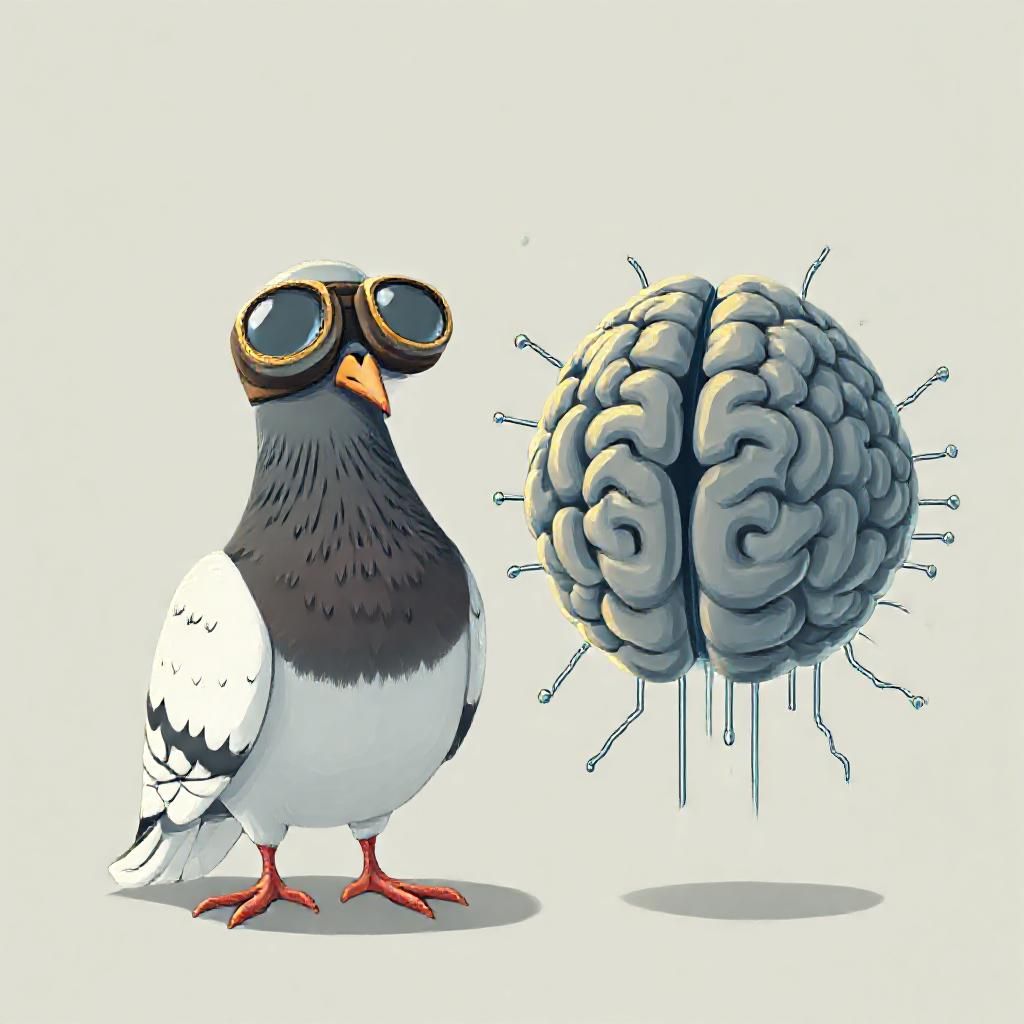
# From Pigeons to Precision: The Unlikely Origins of AI
In the world of technology, inspiration can come from the most unexpected places. One of the most intriguing stories is how the humble pigeon contributed to the development of artificial intelligence (AI). During the chaos of World War II, while physicists worked tirelessly on the Manhattan Project, psychologist B.F. Skinner embarked on a unique mission. His goal wasn’t to create more destructive weapons but to increase the precision of conventional bombs.
## The Pigeon Project
In 1943, Skinner proposed an innovative idea: using pigeons to guide bombs to their targets. This was part of a secret government initiative known as Project Pigeon. The concept was simple yet revolutionary. Pigeons, trained to peck at a target image, would sit inside the nose of a bomb. As the bomb fell, the pigeons would peck at the screen displaying the target. Their movements would adjust the bomb’s trajectory, increasing its accuracy.
Despite seeming whimsical, Skinner’s project was grounded in rigorous behavioral psychology. He had already demonstrated that pigeons could be trained to perform complex tasks through operant conditioning. Although Project Pigeon never saw operational use, it was the precursor to later advancements in guided missile technology and autonomous systems.
## A Pioneering Step Towards AI
While Skinner’s pigeons never flew in combat, his work highlighted a fundamental principle of AI: using simple, repeatable actions to achieve complex results. This concept mirrors how modern AI systems use large datasets and simple algorithms to perform highly sophisticated tasks.
Today’s AI systems, such as neural networks, rely on learning from enormous amounts of data to make predictions or decisions. This process echoes Skinner’s training methods, albeit with silicon-based processors rather than avian participants. In essence, Skinner’s pigeons were a biological prototype of the feedback systems that now underpin AI technologies.
## The Legacy of Skinner’s Vision
B.F. Skinner’s ambitious vision laid some of the groundwork for future technological innovations. While his methods were unconventional, they underscored the importance of lateral thinking in scientific progress. His work serves as a reminder that innovation often requires looking beyond conventional wisdom and exploring seemingly outlandish ideas.
As we witness the rapid evolution of AI today, it’s fascinating to reflect on its diverse origins. The story of Skinner’s pigeons is a testament to the creative spirit that drives technological advancement, showing that even the most improbable ideas can have a profound impact on the future.
## Conclusion
From guiding bombs to guiding digital decision-making processes, the journey from pigeons to AI illustrates the unexpected paths innovation can take. It encourages us to remain open-minded and curious, as the next breakthrough could be lurking in the most unassuming of places.
Join us in celebrating the quirky yet foundational moments in tech history that have shaped the AI landscape we see today.
Leave a Reply