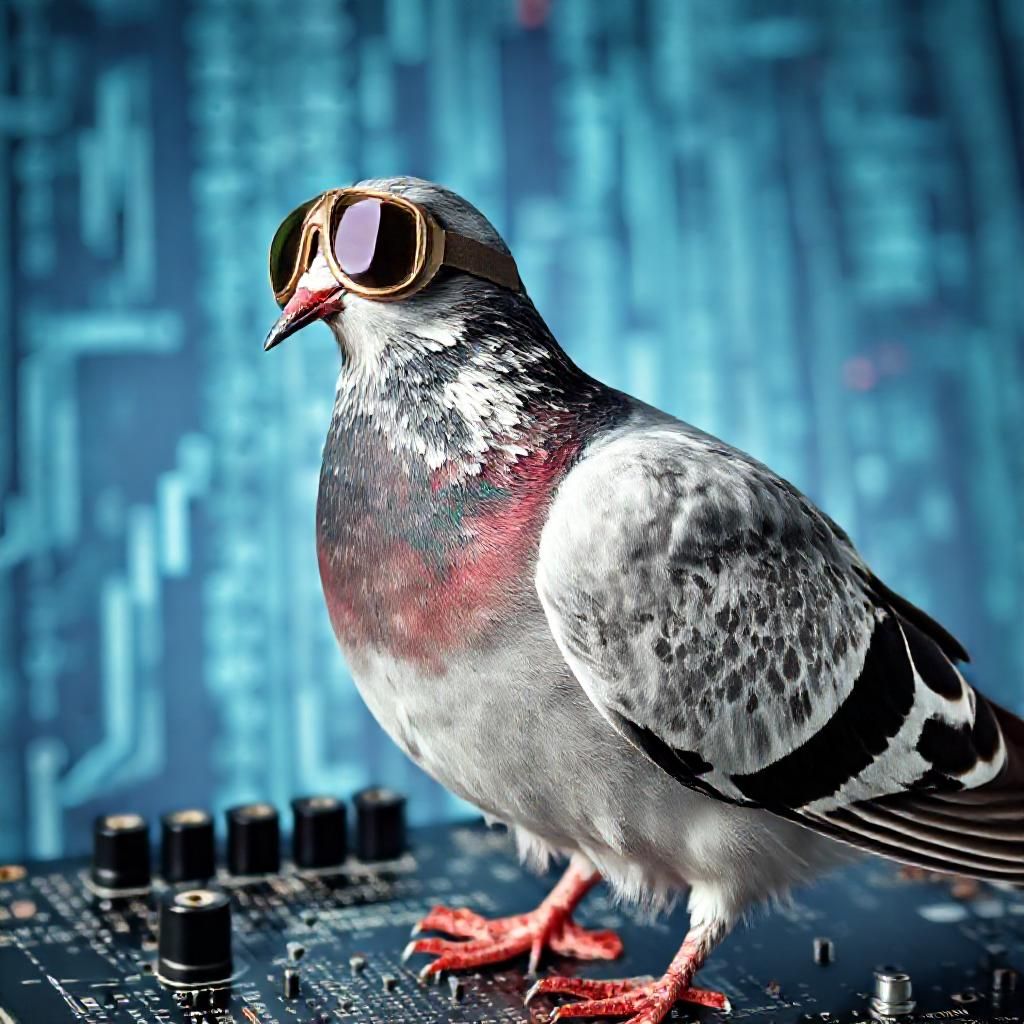
# How Pigeons Paved the Way for AI Innovations
In a world where technology has become an integral part of our lives, it’s intriguing to think that our journey into the realm of artificial intelligence (AI) might owe a nod of gratitude to pigeons. Yes, those humble city-dwelling birds pecking away at breadcrumbs in parks played a pivotal role in the early days of AI research.
## The Unlikely Beginnings
The story begins in 1943, amidst the turmoil of World War II. While major scientific minds were dedicated to splitting atoms for the Manhattan Project, B.F. Skinner, a renowned American psychologist, embarked on a different mission. His goal was not to create a more destructive weapon but to enhance the precision of existing ones. Skinner’s secret government project, known as Project Pigeon, aimed to train pigeons to guide bombs accurately to their targets.
## Project Pigeon: A Feathered Guidance System
Skinner’s innovative concept was simple yet revolutionary. He recognized that pigeons, with their excellent vision and ability to recognize patterns, could be trained to peck at a target displayed on a screen. By placing pigeons inside the nose cone of a bomb, Skinner proposed that they could guide the bomb by pecking at the target image, thus adjusting the bomb’s trajectory.
While Project Pigeon did not ultimately see combat deployment, it laid an unexpected foundation for the development of AI. The principles of operant conditioning and behaviorist psychology that Skinner employed in training pigeons to respond to stimuli are akin to the learning algorithms we see in AI today.
## The Legacy of Pigeons in AI
Fast forward to today’s AI landscape, these early lessons in behavior modification have evolved into sophisticated machine learning algorithms. Modern AI systems, like neural networks, learn from vast datasets by identifying patterns and making predictions, much like Skinner’s pigeons learned to peck at targets.
This historical anecdote emphasizes the unpredictable nature of innovation. It reminds us that technological advancements often stem from unconventional ideas and seemingly unrelated fields.
## A Tribute to Unlikely Innovators
As we marvel at the capabilities of AI today, from autonomous vehicles to personalized recommendations, it’s worth reflecting on the unlikely contributors to this technological revolution. Pigeons, through their role in Skinner’s project, demonstrate that inspiration can come from the most unexpected places.
Next time you encounter a pigeon, consider it a symbol of innovation and the curious pathways that lead to technological breakthroughs. Who would have thought that these birds, often overlooked in urban settings, would have such a profound influence on the future of AI?
## Conclusion
The influence of B.F. Skinner’s Project Pigeon on AI development is a testament to the unpredictable and interconnected nature of scientific discovery. It serves as a reminder that the next big breakthrough could be nesting where we least expect it.
Leave a Reply