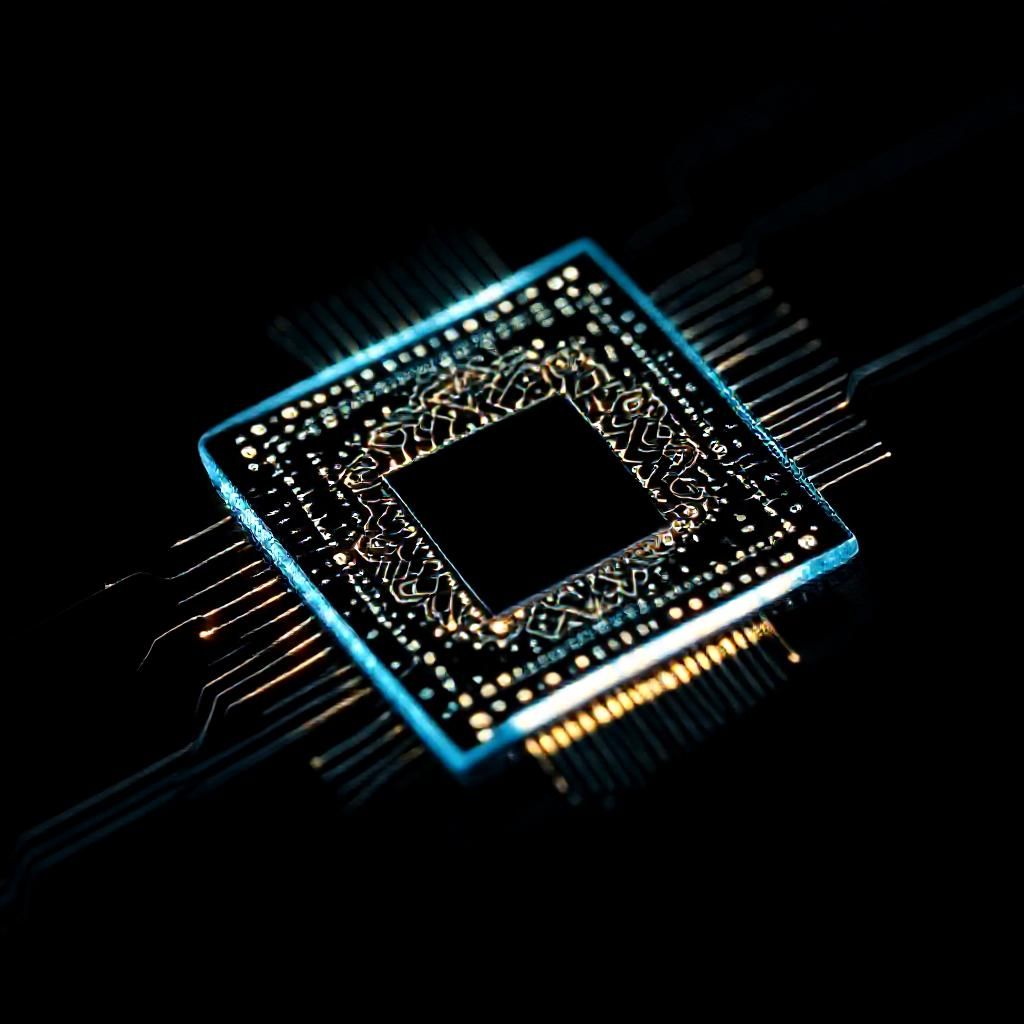
### Harvard’s Ultra-Thin Chip: A Quantum Leap in Computing
Imagine a world where quantum computing, often associated with complex and cumbersome setups, is as compact and efficient as the smartphone in your pocket. This vision took a significant step towards reality thanks to groundbreaking research from Harvard University. The team has developed an ultra-thin metasurface chip that could potentially transform how quantum computing operates.
#### The Power of Metasurfaces
Traditional quantum computing relies heavily on bulky optical components to manipulate and entangle photons, the workhorses of quantum information. These components are not only large but also intricate, making scalability a major hurdle. Enter the metasurface: a nanostructured layer, thinner than a human hair, designed to perform the same functions as its cumbersome predecessors.
Using the principles of graph theory, the Harvard team has simplified the design of these metasurfaces. This approach allows the metasurface to generate entangled photons and carry out complex quantum operations with unprecedented efficiency and precision.
#### A Leap Towards Scalability and Stability
One of the most exciting implications of this technology is its potential to make quantum networks much more scalable and stable. By minimizing the apparatus needed to perform quantum operations, we can envision a future where quantum computing is more accessible and practical, even at room temperature. This development could revolutionize fields like cryptography, drug discovery, and complex system simulations, where quantum computing has already shown immense potential.
#### The Road Ahead
While this innovation marks a significant milestone, there are still challenges to overcome. Integrating these metasurfaces into existing quantum systems and ensuring they perform consistently in real-world scenarios will require further research and development. However, the promise of a more compact, efficient, and scalable quantum computing infrastructure is an exciting prospect that could redefine technological boundaries.
As we continue to push the limits of what’s possible with quantum technology, innovations like Harvard’s ultra-thin chip remind us of the incredible potential that lies at the intersection of nanotechnology, photonics, and quantum computing. The future of computing is getting smaller, faster, and closer than ever before.
Leave a Reply