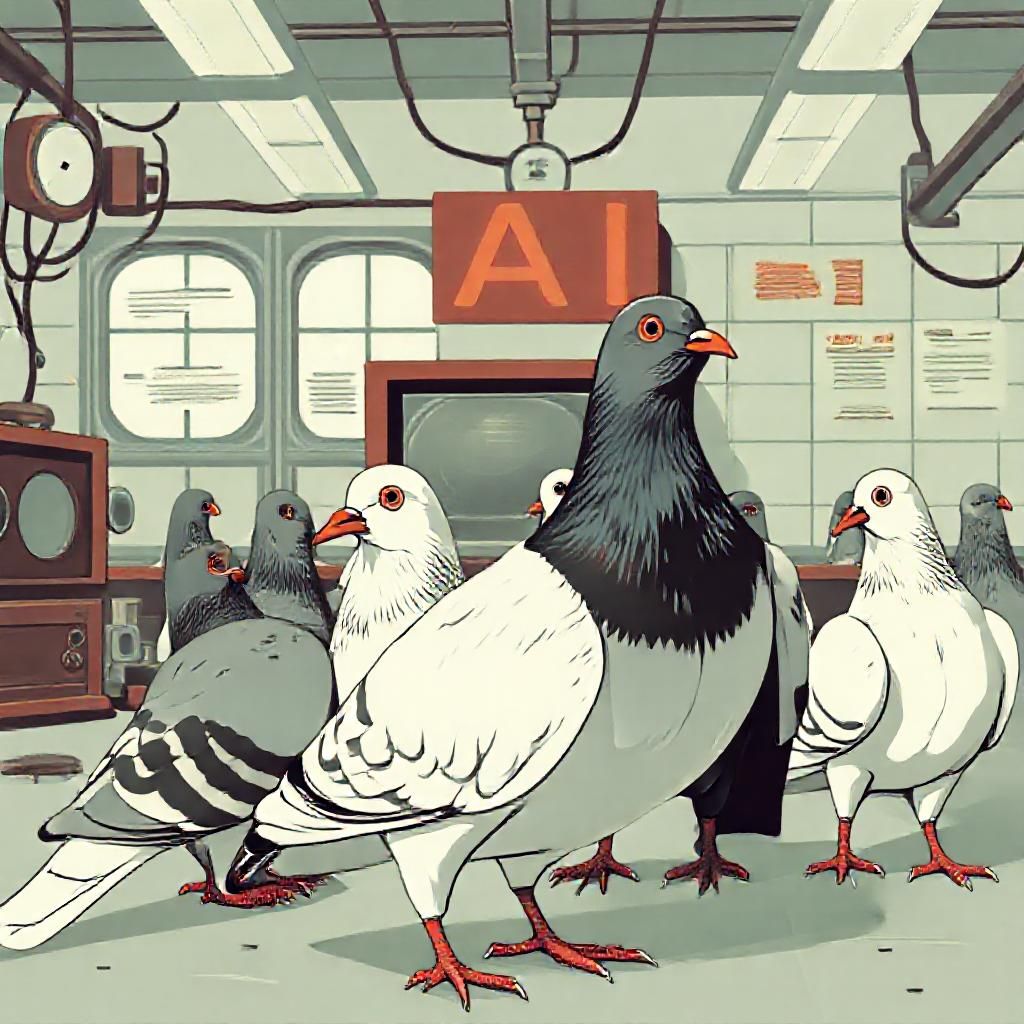
# The Feathered Architects of AI: How Pigeons Paved the Path for Modern Technology
In a world dominated by sleek algorithms and powerful processors, it’s hard to imagine that the humble pigeon once played a pivotal role in advancing technology. Yet, as surprising as it sounds, these everyday birds were at the heart of a wartime project that foreshadowed some of the precision capabilities we take for granted today in artificial intelligence (AI).
## The Unlikely Hero: B.F. Skinner’s Pigeons
In 1943, amidst the global turmoil of World War II, B.F. Skinner, an American psychologist renowned for his work in behaviorism, embarked on a unique mission. While physicists were busy with the Manhattan Project, Skinner conceived a plan to enhance the accuracy of conventional bombs. His idea was not to create more destructive weapons, but rather to make existing ones smarter.
Skinner’s project, known as Project Pigeon, aimed to train pigeons to guide missiles to their targets. Using operant conditioning, a method where behaviors are modified through rewards or punishments, Skinner taught pigeons to peck at a target image projected inside a missile nose cone. The pigeons’ pecking would adjust the trajectory of the bomb, steering it towards its intended target with remarkable precision.
## From Feathers to Code: The Legacy of Project Pigeon
Though Project Pigeon never saw action in the war, the concept of biological control systems laid foundational ideas for the future of AI. The notion of using feedback loops to refine and improve accuracy is a principle that echoes through modern-day machine learning and neural network designs.
Fast forward to the present, AI systems utilize vast amounts of data and intricate algorithms to ‘learn’ and make decisions. The principle remains similar: feedback is used to enhance performance, much like Skinner’s pigeons used their sensory inputs to guide missiles.
## A Feather in AI’s Cap
While today’s AI isn’t guided by pigeons, the essence of Skinner’s experiment lives on in the sophisticated systems we rely on today. The inspiration drawn from his work is a testament to the innovative spirit that continues to drive technological advancement.
As AI continues to evolve, it’s intriguing to look back at the unexpected origins of these technologies. The next time you marvel at the precision of AI, you might just find yourself tipping your hat to the wartime pigeons and the psychologist who dared to dream beyond the conventional realms.
## Conclusion
The story of B.F. Skinner’s pigeons is a reminder that innovation often comes from the most unexpected places. In our pursuit of future tech advancements, perhaps we should keep our eyes open to unconventional ideas and inspirations, as they might just lead to the next big breakthrough.
—
**What’s your take on unusual innovations? Share your thoughts in the comments below!**
Leave a Reply