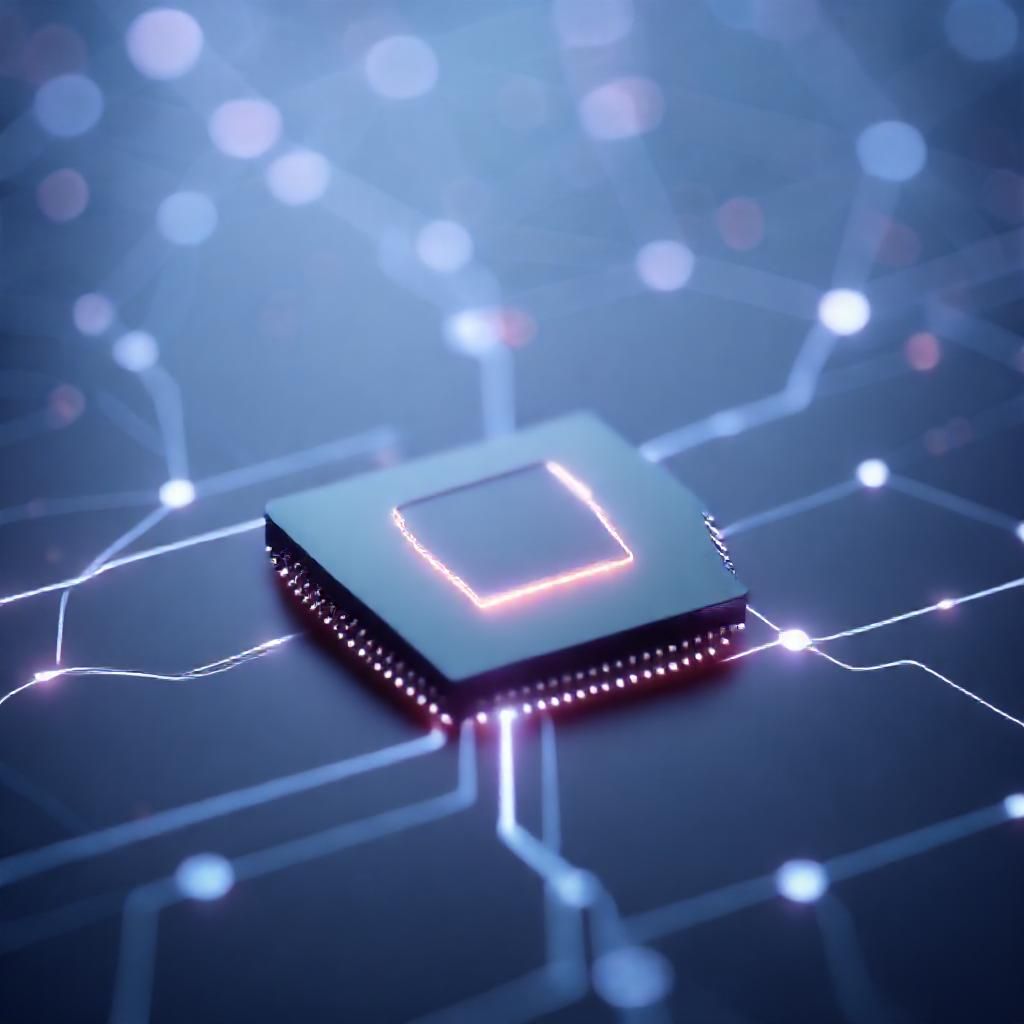
# Harvard’s Ultra-Thin Chip: A Quantum Leap in Computing
In the world of technology, where smaller often means more powerful, a new innovation from Harvard is turning heads. Imagine a chip as thin as a strand of hair, yet capable of performing complex quantum operations. This is not science fiction—it’s the future of quantum computing.
Harvard researchers have developed a groundbreaking metasurface that could simplify and revolutionize the way quantum computing systems are built. Traditionally, these systems rely on bulky optical components that are not only complex but also challenging to scale. However, this new metasurface, thanks to its ultra-thin, nanostructured design, can replace these cumbersome parts, paving the way for more compact and stable quantum networks.
## The Magic of Metasurfaces
So, what exactly is a metasurface? At its core, it’s a highly engineered surface with nanoscale features that manipulate light in sophisticated ways. The Harvard team utilized this technology to create a metasurface that can generate entangled photons and execute intricate quantum operations—all on a chip thinner than a human hair.
The significance of this advancement cannot be overstated. By employing graph theory, the researchers were able to streamline the design of these metasurfaces. Graph theory, a mathematical framework used to study networks and relationships, allowed them to optimize the metasurface layout for maximum efficiency in quantum operations.
## Why This Matters
Quantum computing holds the promise of solving problems that are currently unsolvable with classical computers. However, one of the biggest hurdles in quantum technology is the development of scalable and stable systems that can operate at room temperature. The innovation from Harvard addresses these challenges head-on by providing a compact solution that could be more easily integrated into existing technology infrastructures.
Moreover, this development is not just about making systems smaller. With the potential to enhance quantum networks’ scalability and stability, it could accelerate the practical application of quantum computing in various fields, from cryptography to complex data analysis.
## Looking Ahead
While the Harvard metasurface is still in the research phase, its potential impacts are vast. It represents a significant step forward in making quantum computing more accessible and practical for real-world applications. As researchers continue to refine this technology, we might soon see it forming the backbone of the next generation of quantum networks.
In the fast-evolving landscape of technology, staying ahead means rethinking the fundamentals. Harvard’s ultra-thin chip not only redefines what’s possible in quantum photonics but also challenges us to envision a future where the quantum realm is within reach.
Stay tuned as we watch this space and witness the unfolding of a quantum revolution.
Leave a Reply