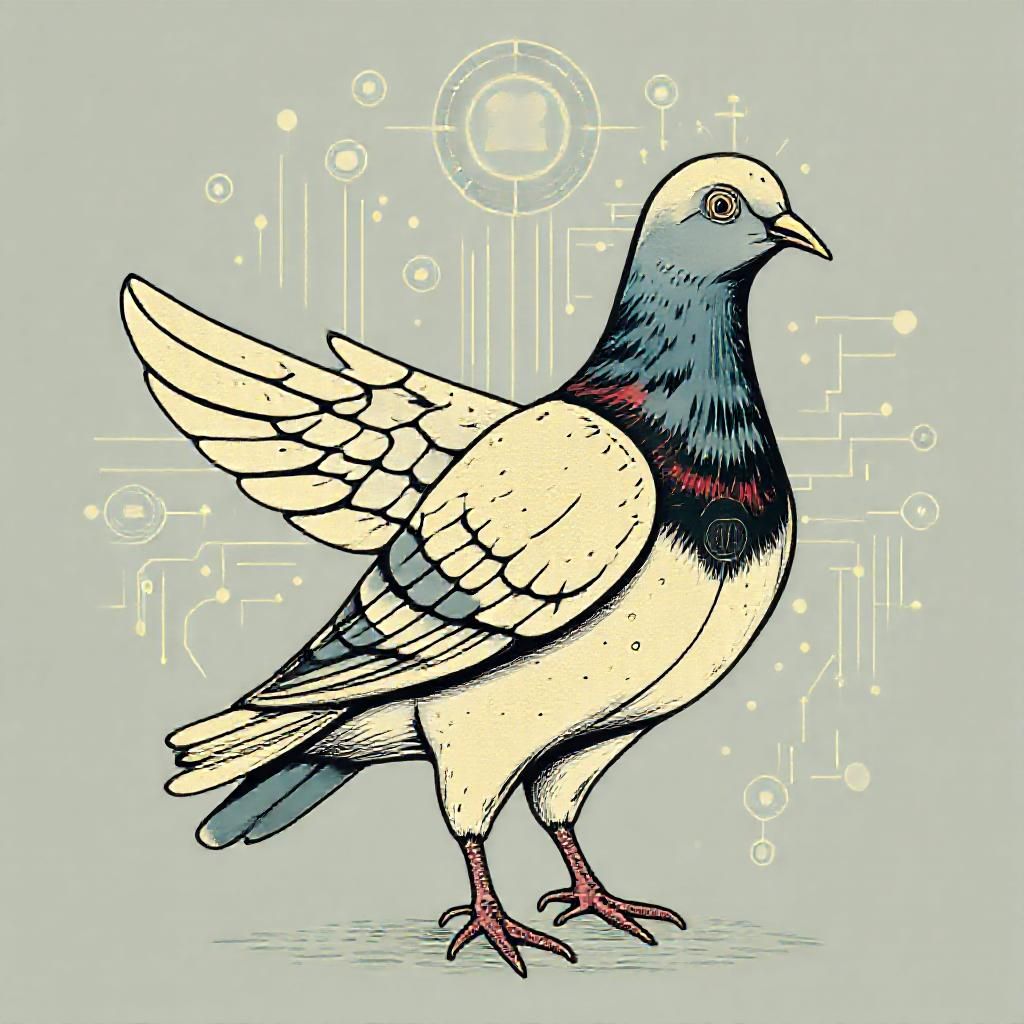
# From Pigeons to Precision: How WWII Inspired Modern AI
In the midst of World War II, while the world anxiously followed the Manhattan Project’s nuclear ambitions, another secret endeavor was quietly taking shape—one with a feathered twist. The protagonist of this unconventional tale was not an engineer, but an American psychologist named B.F. Skinner. His mission? To harness the humble pigeon to improve the accuracy of conventional bombs, a visionary idea that would eventually echo through the halls of modern artificial intelligence (AI) research.
## The Avian Architects of Precision
B.F. Skinner, renowned for his work in behaviorism, believed that pigeons could be trained to guide bombs with greater precision than the technology of the time allowed. His project, known as Project Pigeon (or Project Orcon), aimed to equip bombs with small capsules containing pigeons. These pigeons were trained to peck at a target image projected onto a screen, correcting the bomb’s course in real-time by adjusting its trajectory based on their pecking.
Though it sounds fantastical, this idea wasn’t as far-fetched as it might seem. Skinner’s pigeons were remarkably adept at recognizing patterns and making quick decisions—skills that resonate with the pattern recognition capabilities of modern AI systems. While the project was ultimately shelved in favor of emerging electronic guidance systems, it set a precedent for thinking outside the box and leveraging biology in technological innovation.
## From Feathered Friends to Neural Networks
Fast forward to today, and the legacy of Skinner’s work can be seen in the AI algorithms that permeate our daily lives. The principles of behaviorism—reward and reinforcement—are echoed in the machine learning models that drive advancements in fields from natural language processing to autonomous vehicles. Just as pigeons learned to align their behavior with desired outcomes, AI systems are trained to optimize their performance by adjusting to feedback.
Interestingly, the concept of using biological processes to inspire technological solutions is a cornerstone of AI development. Neural networks, a foundational technology in AI, are modeled after the structure and function of the human brain. This biomimicry has led to breakthroughs in areas like image recognition and speech synthesis, making technology more intuitive and efficient.
## The Unseen Legacy of Project Pigeon
While Project Pigeon might not have taken flight in its original form, its influence is undeniable. It represents a critical moment in the history of AI, where creativity and unconventional thinking paved the way for future innovations. Skinner’s approach reminds us that sometimes the most groundbreaking ideas come from the most unexpected places.
As we continue to explore the potential of AI, it’s important to remember the lessons from our feathered guides of the past. Innovation often requires looking beyond conventional wisdom and daring to imagine the improbable. In that spirit, we owe a nod of gratitude to the pigeons and the psychologist who saw their potential to change the course of history.
In a world where AI continues to evolve at a staggering pace, perhaps the story of Project Pigeon serves as a timely reminder: the seeds of innovation are often planted in the most unlikely of gardens.
Leave a Reply