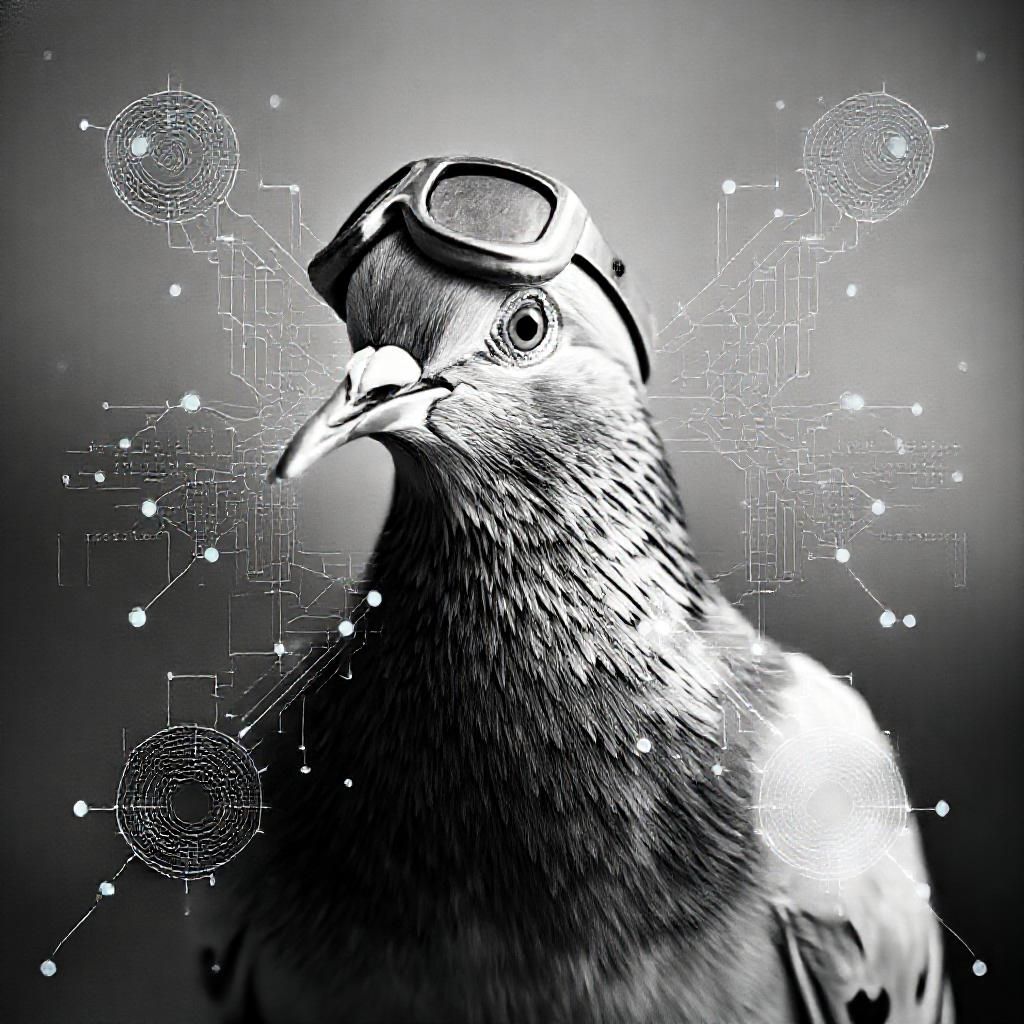
### From Feathers to Algorithms: How Pigeons Paved the Way for AI
In the midst of World War II, while physicists were unlocking the secrets of the atom, a peculiar experiment was unfolding that involved none other than pigeons. Under the guidance of American psychologist B.F. Skinner, these birds were trained to peck at targets on a screen, guiding missiles more accurately to their destinations. While this project, known as Project Pigeon, never saw action, it laid the groundwork for ideas that would later inspire artificial intelligence.
#### The Pigeon Project: A Flight of Innovation
In 1943, Skinner’s unconventional approach to warfare aimed to solve a critical issue: the precision of bombing raids. Traditional methods lacked the accuracy needed to minimize collateral damage and maximize impact on strategic targets. Skinner’s solution was to incorporate pigeons into missile guidance systems. These birds, with their remarkable ability to distinguish patterns and shapes, were trained to peck at images of targets projected onto a screen. Their pecking would keep the missile on course until it reached its target.
Though the project was eventually shelved in favor of more advanced electronic systems, the underlying principles of behavior shaping and pattern recognition resonated with future generations of researchers. These concepts would later become fundamental to the development of machine learning and AI.
#### Bridging the Past and Present
Today, artificial intelligence thrives on its ability to recognize patterns and make decisions based on data input, much like Skinner’s pigeons. The methods of reinforcement learning, where algorithms improve through feedback, echo the behaviorist principles Skinner championed in his time. AI systems learn by being “rewarded” for correct predictions, similar to how pigeons were trained by receiving food for accurate pecks.
The journey from pigeons to algorithms is a testament to the unexpected paths of innovation. It highlights how historical experiments can spark ideas that transcend their original purpose and shape future technologies. While pigeons are no longer guiding missiles, the legacy of their contribution lives on in the algorithms that drive our modern world.
#### A Feathered Legacy
As we marvel at the wonders of AI today, it’s worth pausing to appreciate the quirky and unexpected origins of these technologies. From the flapping of pigeons’ wings to the hum of data-driven algorithms, the evolution of precision and learning in technology is a fascinating tale of ingenuity. Next time you encounter an AI marvel, perhaps spare a thought for the pigeons who, unbeknownst to them, once played a part in this grand narrative.
So, the next time you’re amazed by a self-driving car or a smart assistant, remember that we owe a feathered thank you to those humble pigeons and the visionary psychologist who saw potential in their pecks.
Leave a Reply