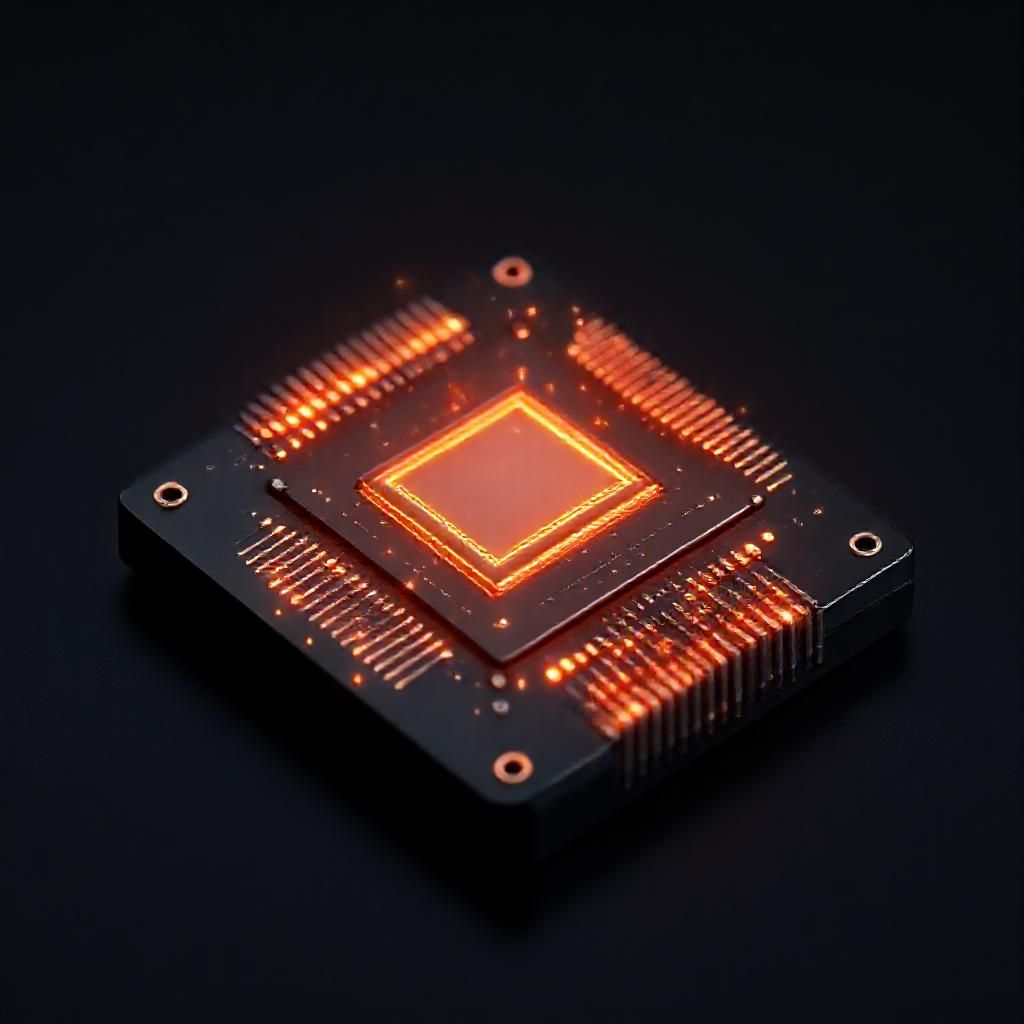
### Harvard’s Ultra-Thin Quantum Chip: A New Era for Computing
In the ever-evolving landscape of technology, quantum computing stands out as a beacon of futuristic promise. But what if the future could be ushered in sooner than we thought? Researchers at Harvard have developed a nanoscale metasurface that might just do that. This groundbreaking innovation could simplify the complex optical components traditionally used in quantum computing, making them as thin as a human hair.
#### What is a Metasurface?
At its core, a metasurface is an artificially engineered surface with properties that can manipulate electromagnetic waves in novel ways. Harvard’s team has harnessed this technology to create a metasurface that performs the tasks of typically bulky optical elements, used in generating and manipulating entangled photons, on a compact scale.
#### The Quantum Leap
The implications of this development are profound. Quantum computing relies heavily on entangled photons to perform calculations beyond the reach of classical computers. By miniaturizing the components needed to generate these photons, Harvard’s metasurface technology could reduce the size and complexity of quantum systems, making them more scalable and stable.
#### The Role of Graph Theory
One of the most fascinating aspects of this research is how the team utilized graph theory—a field of mathematics focused on the study of graphs, which are mathematical structures used to model pairwise relations between objects. By applying graph theory, they were able to design the metasurfaces with precision, ensuring that they could efficiently perform sophisticated quantum operations.
#### Room-Temperature Revolution
Notably, these advancements are achieved at room temperature, which is a significant leap forward. Traditional quantum computers often require extremely cold temperatures to operate, which limits their practicality and scalability. Harvard’s metasurfaces open up the potential for more accessible quantum technology.
#### Implications and Future Prospects
As we move forward, this innovation could herald a new era of quantum computing. By substantially reducing the size and complexity of quantum components, we could see more widespread adoption and integration of quantum technology in various industries, from cryptography to material science.
Ultimately, Harvard’s ultra-thin metasurface could be the first step towards a quantum computing revolution that fits neatly on a chip.
Stay tuned as we continue to explore how this and other breakthroughs will shape the future of computing and beyond.
Leave a Reply